
Department of Civil Engineering | LNCT Group of Colleges
We inspire innovation and discovery at LNCT Group of Colleges.
Department of Civil Engineering | LNCT Group of Colleges
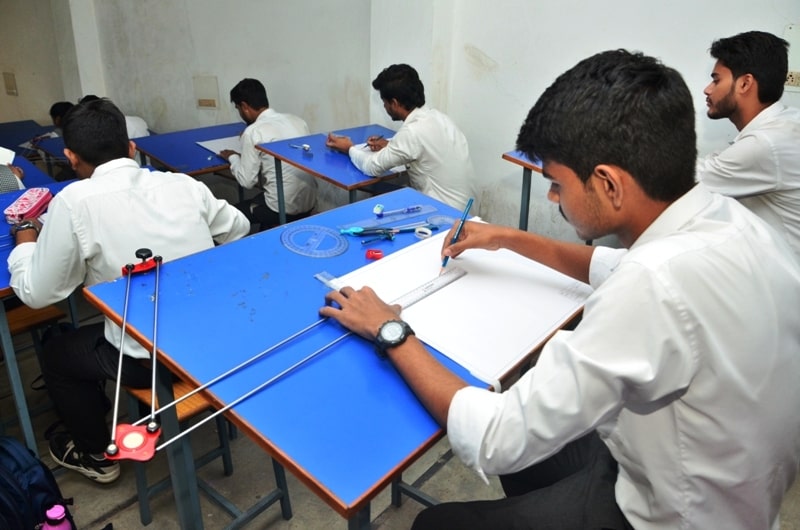
The Department of Civil Engineering is established in 2004, initially with an intake of 30 at undergraduate level and 18 at postgraduate level in 2007. Department has developed over the years with an increase in intake from 60 to 120 at undergraduate program, 24 at postgraduate program at present.
Since inception the department has set new standards over the time presently under the guidance of Department Head and Faculties with the required support of management.
The department is located on the ground floor of the CME block in LNCT campus. The department has qualified, experienced and adequate faculty to meet the requirements of present intake. The department also has adequate no. of laboratories for giving assured quality results for consultancy testing. The department has a computer center and a library for use.
The department strongly believes in making continuous efforts to strive for excellence by exploring new frontiers of knowledge in engineering and technology. It gives to its students the best available instructions of the curriculum. It also conducts regularly national conferences, seminars and special guest lectures for the benefit of faculty, staff and students. It also collaborates actively for academia – industry interactions. The department also communicates suggestions to affiliating university for academic developments. The department also conducts Staff Development Program and national conference with the support of AICTE for faculty members. In the field of academic consultancy the department is a recognized centre in Madhya Pradesh, Bhopal of Institution of Civil Engineers, Karol Bagh, New Delhi.
Research assistance for paper presentation and travel grants for India and abroad are provided by LNCT and government agencies like MPCST, AICTE, DST etc..
B.E./B.Tech. (4 Years Duration)
| College Name | LNCT | LNCTE | LNCT&S |
| Eligibility Criteria | Eligibility-XII with: Physics + Maths + (Chemistry/Computer Science/Biology) with Min. 45% (40% for SC/ST/OBC MP Domicile Candidate) with qualified rank in JEE. Eligibility(Direct/Lateral Entry)-2nd Year. Direct Admission: 1. Min. 45% (40% for SC/ST/OBC) in B.Sc. and passed 12th examination with Maths. 2. Min. 45% (40% for SC/ST/OBC) in Diploma in Engg. |
| Seats | LNCT- 60 | LNCT&S-30 |
| Duration | 4 Years |
M.E./M.Tech. – Construction Technology and Management (CTM)
| College Name | LNCT |
| Eligibility Criteria | Eligibility-B.E./B.Tech. with Min. 50% (45% for SC/ST/OBC MP Domicile Candidate) |
| Seats | LNCT- 30 |
| Duration | 2 Years |
M.E./M.Tech. – Structural Engineering
| College Name | LNCT |
| Eligibility Criteria | Eligibility-B.E./B.Tech. with Min. 50% (45% for SC/ST/OBC MP Domicile Candidate) |
| Seats | LNCT- 30 |
| Duration | 2 Years |
| College Name | Name |
| LNCT | Dr. BIKRAM PRASAD |
| LNCT S | Dr. PRAVEEN K SINGHAI |
Student Chapters and Societies in Department
Vision
To be a fountainhead of innovation, sustainable solutions, and professional excellence in Civil Engineering.
Mission
- To offer quality Civil Engineering programs through effective teaching learning processes, state of the art technology, and strong ethical values.
- To inculcate entrepreneurial skills, professional competence, and leadership qualities among graduating civil engineering students.
- To evolve as a Centre of excellence in Civil Engineering education through innovation, research, industry interaction, and societal engagement.
Program Educational Objectives (PEOs)
- To provide a conducive academic environment and effective teaching–learning processes that establish strong foundations in civil engineering principles and practices.
- To prepare graduates to become employable, ethical, accountable, and professionally competent civil engineers, capable of designing, implementing, and managing civil engineering projects in complex and multidisciplinary environments.
- To motivate graduates towards higher studies, research, innovation, and lifelong learning, enabling them to contribute to academia, research organizations, and advanced professional practice in Civil Engineering.
- To equip graduates with modern engineering tools, software, computational techniques, and emerging technologies, enabling them to demonstrate leadership, entrepreneurial capability, and effective performance in industry and global professional environments.
Program Specific Outcomes (PSOs)
- Apply principles of surveying, mapping, planning, and layout to execute, supervise, and coordinate civil engineering works such as buildings and infrastructure projects in collaboration with multiple agencies.
- Identify, analyze, and propose innovative and sustainable civil engineering solutions for societal and regional needs such as housing, sanitation, waste management, irrigation, and renewable energy systems.
- Plan, analyze, design, and prepare techno-economic cost estimates for civil engineering projects by integrating engineering standards, safety, sustainability, and entrepreneurial considerations.
PROGRAM OUTCOMES (POS)
- PO1: Engineering Knowledge: Apply knowledge of mathematics, natural science, computing, engineering fundamentals and an engineering specialization as specified in WK1 to WK4 respectively to develop to the solution of complex engineering problems.
- PO2: Problem Analysis: Identify, formulate, review research literature and analyze complex engineering problems reaching substantiated conclusions with consideration for sustainable development. (WK1 to WK4)
- PO3: Design/Development of Solutions: Design creative solutions for complex engineering problems and design/develop systems/components/processes to meet identified needs with consideration for the public health and safety, whole-life cost, net zero carbon, culture, society and environment as required. (WK5)
- PO4: Conduct Investigations of Complex Problems: Conduct investigations of complex engineering problems using research-based knowledge including design of experiments, modelling, analysis & interpretation of data to provide valid conclusions. (WK8).
- PO5: Engineering Tool Usage: Create, select and apply appropriate techniques, resources and modern engineering & IT tools, including prediction and modelling recognizing their limitations to solve complex engineering problems. (WK2 and WK6)
- PO6: The Engineer and The World: Analyze and evaluate societal and environmental aspects while solving complex engineering problems for its impact on sustainability with reference to economy, health, safety, legal framework, culture and environment. (WK1, WK5, and WK7).
- PO7: Ethics: Apply ethical principles and commit to professional ethics, human values, diversity and inclusion; adhere to national & international laws. (WK9)
- PO8: Individual and Collaborative Team work: Function effectively as an individual, and as a member or leader in diverse/multi-disciplinary teams.
- PO9: Communication: Communicate effectively and inclusively within the engineering community and society at large, such as being able to comprehend and write effective reports and design documentation, make effective presentations considering cultural, language, and learning differences
- PO10: Project Management and Finance: Apply knowledge and understanding of engineering management principles and economic decision-making and apply these to one’s own work, as a member and leader in a team, and to manage projects and in multidisciplinary environments.
- PO11: Life-Long Learning: Recognize the need for, and have the preparation and ability for i) independent and life-long learning ii) adaptability to new and emerging technologies and iii) critical thinking in the broadest context of technological change. (WK8)